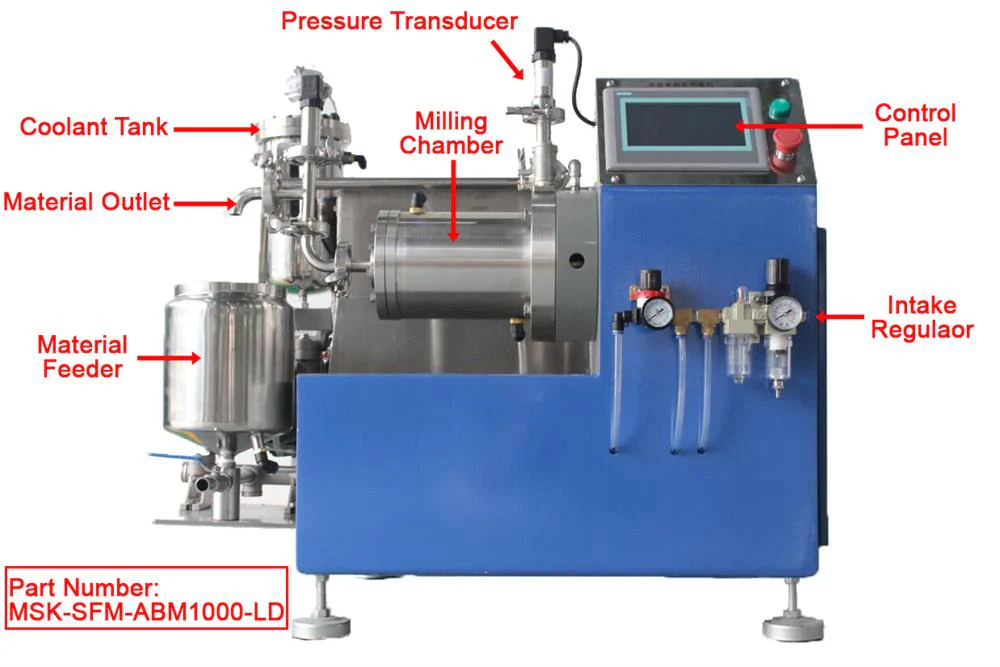

Wet bead mills are essential tools in modern manufacturing, particularly when fine particle size reduction and uniform dispersion are required. Their ability to process materials in a liquid medium makes them highly efficient for industries that demand precision, consistency, and high-quality outputs.
These machines use grinding media and high-speed agitation to break down particles into extremely fine sizes. Many industries rely on a Wet Bead Mill to handle complex formulations that require both grinding and mixing in a single process. This versatility has made wet bead mills a standard solution across a wide range of applications.
Table of Contents
ToggleWhy Wet Bead Mills Are Widely Used
Wet bead mills offer several advantages that make them suitable for diverse industries:
- Consistent particle size distribution
- Efficient processing of high-viscosity materials
- Enhanced dispersion and mixing
- Better temperature control during grinding
These benefits allow manufacturers to achieve reliable and repeatable results.
Key Industrial Applications
Pharmaceuticals
In the pharmaceutical sector, controlling particle size is critical for drug effectiveness. Wet bead mills are commonly used for:
- Reducing active pharmaceutical ingredients (APIs)
- Creating stable suspensions and emulsions
- Improving drug solubility and absorption
Fine particles increase surface area, which enhances dissolution rates and bioavailability.
Paints and Coatings
Wet bead mills play a major role in producing high-quality paints and coatings. They are used to:
- Disperse pigments evenly
- Eliminate particle agglomeration
- Improve color strength and consistency
This results in smoother finishes and better product performance.
Food and Beverage Industry
Consistency and texture are vital in food production. Wet bead mills are applied in:
- Chocolate and cocoa processing
- Nut butters and spreads
- Sauces and dressings
The liquid-based grinding process helps maintain flavor integrity while achieving uniform textures.
Cosmetics and Personal Care
In cosmetics, product feel and stability are crucial. Wet bead mills are used for:
- Creams and lotions
- Sunscreens
- Makeup products with pigments
They ensure fine particle dispersion, leading to smoother application and improved product quality.
Chemical Processing
Wet bead mills are widely used in the chemical industry for handling complex formulations. Applications include:
- Specialty chemicals
- Adhesives and sealants
- Agrochemical suspensions
They help achieve consistent mixing and precise particle sizes.
Advanced Materials and Nanotechnology
Wet bead milling is also important in high-tech industries. It is used for:
- Producing nanoparticles
- Processing advanced ceramics
- Developing functional coatings
The ability to control particle size at the micro and nano level is essential for these applications.
Benefits Across Industries
The widespread use of wet bead mills is driven by their ability to meet demanding production requirements. Key benefits include:
- High efficiency and productivity
- Uniform and repeatable results
- Reduced processing time
- Scalability for industrial production
These advantages make them a reliable choice for both small-scale and large-scale operations.
Factors That Influence Application Success
To achieve optimal results, several factors must be carefully controlled:
- Bead size and material: Determines grinding efficiency
- Processing speed: Affects energy transfer
- Viscosity of the mixture: Influences flow and dispersion
- Milling duration: Controls final particle size
Proper optimization ensures that the process meets specific industry requirements.
Conclusion
Wet bead mills have become indispensable across a wide range of industries due to their efficiency, versatility, and ability to produce fine, uniform particles. From pharmaceuticals and food processing to advanced materials and coatings, their applications continue to expand as technology evolves.
By enabling precise particle size reduction and consistent dispersion, wet bead mills support innovation and quality in modern manufacturing processes.